
Microplastics on the Move
About this Article
Lines of Inquiry
- Connections among water, air, dust, soil, and living systems as microplastics travel.
- Changes in a particle’s location as it settles, washes away, becomes airborne, or moves again.
- The difficulty of tracing particles that can pass through several environments.
Guiding Questions
- How can one tiny plastic particle become part of several different environmental systems over time?
- Why might knowing where a microplastic particle is found now not tell us where it originally came from?
- What makes tiny particles able to travel in ways that a large plastic object cannot?
Microplastics on the Move
Tiny Plastic Can Travel
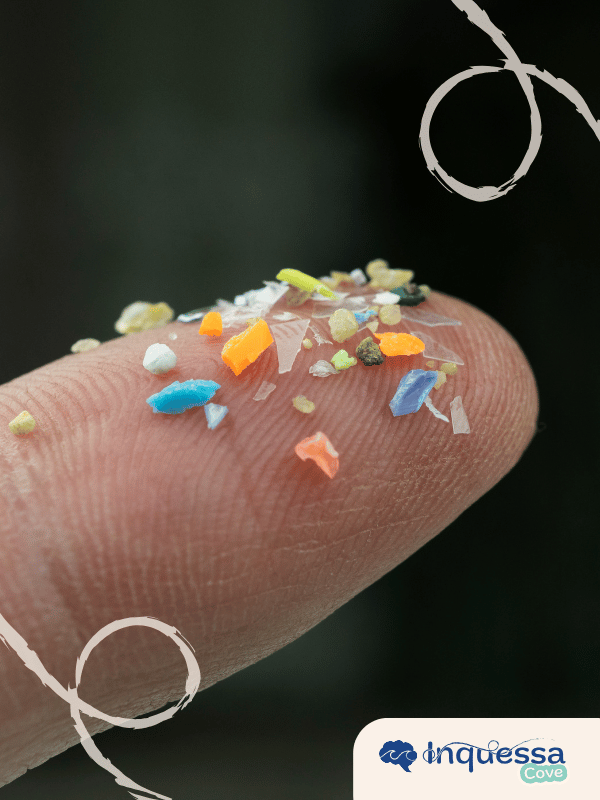
Microplastics are small enough to move through water, air, and soil. Their path depends on where they begin and what moves them.
A particle released in one place may later settle somewhere else. This movement makes it difficult to trace every piece back to its source.
Moving Through Water
Some microfibers and other particles enter wastewater, used water that leaves homes, schools, businesses, or other places through drains.
Treatment systems can remove some particles, but not every particle follows the same path. Microplastics can also move through rivers, runoff, and other water systems.
Carried in Air and Dust
Tiny plastic can become airborne particles, small pieces that travel through the air.
Indoor air can contain up to eight times more suspended microplastic particles than outdoor air. Settled indoor dust can contain about 30 times more. Fibers from clothing and other indoor materials can add particles to dust.
Mixing Into Soil
Microplastics can also enter agricultural soil, soil used for growing crops or raising food.
One kilogram of some agricultural soils can contain up to 40,000 microplastic particles. Particles can arrive through water, wind, some fertilizers or soil treatments, and other pathways.
Pathways Through Living Systems
Plants and animals may encounter microplastics in water, soil, food, or air. Different organisms come into contact with particles in different ways.
This does not mean every particle moves through the same living things. It shows that plastic can become part of many connected environmental pathways.
Why Movement Makes Tracking Difficult
A particle can move from one system to another. It may travel in air, settle on soil, wash into water, or be carried farther away.
Because microplastics are tiny and widespread, scientists often study patterns and samples rather than trying to follow one particle from start to finish.
Tiny Pieces That Travel
Microplastics are small enough to move through many connected parts of the environment. A particle may begin in one place and later be carried somewhere else by water, wind, dust, soil, or living things.
These pathways often overlap. A particle washed from clothing might enter a drain, while another may be blown from a dry surface or carried away by runoff after rain. Instead of staying where they first appear, microplastics can move from one system into another.
Moving Through Water
Water provides many routes for tiny plastic particles. Rain can wash them from roads and other surfaces into drains, streams, and rivers. Used water from homes can carry them into treatment systems.
Wastewater, used water containing waste and pollutants, can move microplastics from homes into treatment systems. As wastewater moves through connected water systems, it can carry microplastics with it. Rivers can then move particles farther downstream, connecting inland areas with coasts and oceans.
Carried in Air and Dust
Microplastics do not travel only through water. Very small pieces can mix with dust, become lifted into the air, and move between places.
Airborne particles, particles such as microplastics carried in air, can move through wind and dust. Indoor air can contain up to eight times more suspended microplastic particles than outdoor air. Settled indoor dust can contain about 30 times more. Tiny plastics can therefore travel through air and collect in places far from rivers or oceans.
Mixing Into Soil
Land is another part of the system. Microplastics can enter soil through runoff, dust, water, and materials used on the ground.
Soil used for growing crops or raising food and managed as part of farming is agricultural soil. Plastic farming sheets can add tiny pieces to these soils as they wear or break apart. One kilogram of some agricultural soils can contain up to 40,000 microplastic particles. Once these particles mix into the ground, plastic pollution becomes part of a land system as well as a water or air problem.
Pathways Through Living Systems
Living things can also become part of microplastic movement. Organisms take in materials from the water, soil, air, and food around them, so tiny plastic particles may enter some feeding relationships.
This does not mean every particle follows the same path through a food web. Living systems simply add another possible route. A particle may move through water first, settle into soil later, or become part of a feeding relationship along the way.
Why Movement Makes Tracking Difficult
Tracking microplastics is difficult because their pathways can change as they travel. A particle carried by runoff may enter a river, settle into sediment, mix with soil, or later move again through wind, water, or living systems.
Their small size allows them to pass between connected environments instead of following one clear route from beginning to end. That movement makes microplastics difficult to keep in one place and difficult to follow through the environment.
Tiny Pieces That Travel
Microplastics are small enough to move through many connected parts of the environment. A particle may begin in one place and later be carried elsewhere by water, wind, dust, soil, or living things.
These pathways often overlap. A particle washed from clothing might enter a drain, while another may be blown from a dry surface or carried away by runoff after rain. Instead of staying where they first appear, microplastics can shift from one system into another.
Moving Through Water
Water provides many routes for tiny plastic particles. Rain can wash them from roads and other surfaces into drains, streams, and rivers. Used water from homes can carry them into treatment systems.
Wastewater is used water that contains waste or other unwanted substances and often must be treated before returning to the environment. As wastewater moves through connected water systems, it can carry microplastics with it. Rivers can then move particles farther downstream, linking inland areas with coasts and oceans.
Carried in Air and Dust
Microplastics do not travel only through water. Very small pieces can mix with dust, become lifted into the air, and move between places.
These tiny materials are examples of airborne particles, which are particles carried through the air. Wind, movement, and disturbed dust can shift them through both indoor and outdoor spaces. Indoor air can contain up to eight times more suspended microplastic particles than outdoor air. Settled indoor dust can contain about 30 times more. Tiny plastics can therefore travel through air and collect in places far from rivers or oceans.
Mixing Into Soil
Land is another part of the system. Microplastics can enter soil through runoff, dust, water, and materials used on the ground.
Agricultural soil is soil used and managed for growing crops or supporting other forms of food production. Plastic farming sheets can add tiny pieces to these soils as they wear or break apart. One kilogram of some agricultural soils can contain up to 40,000 microplastic particles. Once these particles mix into the ground, plastic pollution becomes part of a land system as well as a water or air problem.
Pathways Through Living Systems
Living things can also become part of microplastic movement. Organisms take in materials from the water, soil, air, and food around them, so tiny plastic particles may enter some feeding relationships.
This does not mean every particle follows the same path through a food web. Living systems simply add another possible route. A particle may move through water first, settle into soil later, or become part of a feeding relationship along the way.
Why Movement Makes Tracking Difficult
Tracking microplastics is difficult because their pathways can change as they travel. A particle carried by runoff may enter a river, settle into sediment, mix with soil, or later move again through wind, water, or living systems.
Their small size allows them to pass between connected environments instead of following one clear route from beginning to end. That movement makes microplastics difficult to keep in one place and difficult to follow through the environment.
Tiny Pieces That Travel
Microplastics are small enough to move through many connected parts of the environment. A particle may begin in one place and later be carried elsewhere by water, wind, dust, soil, or living things.
These pathways often overlap. A particle washed from clothing might enter a drain, while another may be blown from a dry surface or carried away by runoff after rain. Instead of remaining where they first appear, microplastics can therefore shift from one environmental system into another.
Moving Through Water
Water provides many routes for tiny plastic particles. Rain can wash them from roads and other surfaces into drains, streams, and rivers, while used water from homes can carry them into treatment systems.
Wastewater is used water that contains waste or other unwanted substances and often must be treated before returning to the environment. As wastewater moves through connected water systems, it can carry microplastics with it. Rivers can then move particles farther downstream, linking inland areas with coasts and oceans.
Carried in Air and Dust
Microplastics do not travel only through water. Very small pieces can mix with dust, become lifted into the air, and move between places.
These tiny materials are airborne particles, or particles carried through the air. Wind, movement, and disturbed dust can shift them through both indoor and outdoor spaces. Indoor air can contain up to eight times more suspended microplastic particles than outdoor air, while settled indoor dust can contain about 30 times more. Tiny plastics can therefore travel through air and collect in places far from rivers or oceans.
Mixing Into Soil
Land is another part of the system. Microplastics can enter soil through runoff, dust, water, and materials used on the ground.
Agricultural soil is soil used and managed for growing crops or supporting other forms of food production. Plastic farming sheets can add tiny pieces to these soils as they wear or break apart. One kilogram of some agricultural soils can contain up to 40,000 microplastic particles. Once these particles mix into the ground, plastic pollution becomes part of a land system as well as a water or air problem.
Pathways Through Living Systems
Living things can also become part of microplastic movement. Organisms take in materials from the water, soil, air, and food around them, so tiny plastic particles may enter some feeding relationships.
However, this does not mean every particle follows the same path through a food web. Living systems simply add another possible route. A particle may move through water first, settle into soil later, or become part of a feeding relationship somewhere along the way.
Why Movement Makes Tracking Difficult
Tracking microplastics is difficult because their pathways can change as they travel. A particle carried by runoff may enter a river, settle into sediment, mix with soil, or later move again through wind, water, or living systems.
Their small size allows them to pass between connected environments instead of following one clear route from beginning to end. As a result, microplastics can be difficult both to keep in one place and to follow through the environment.
Key Vocabulary
pathway (noun) ️ A route through which something moves from one place or system to another. (route, course)
runoff (noun) ️ Water that flows across land or hard surfaces and can carry material with it. (surface flow, drainage)
treatment system (noun) A system that processes used water before it returns to the environment or is reused. (water-treatment system, processing system)
suspended (adjective) ️ Floating or held within air or water instead of resting on a surface. (floating, airborne)
settled dust (noun) Tiny particles that have fallen from the air and collected on surfaces. (surface dust, deposited dust)
disturbed dust (noun) Dust that has been moved or lifted back into the air. (stirred-up dust, airborne dust)
sediment (noun) Small particles of soil, sand, or other material that settle at the bottom of water or on land. (deposited material, particles)
farming sheet (noun) Plastic material placed over or around agricultural soil for purposes such as controlling weeds or conserving moisture. (agricultural plastic sheet, farm covering)
feeding relationship (noun) A connection between organisms based on what eats what. (food relationship, feeding connection)
environmental system (noun) A connected part of the environment, such as air, water, soil, or a living system. (natural system, environmental network)
particle (noun) A very small piece of a material. (tiny piece, speck)
shift (verb) To move or change from one place, condition, or system to another. (move, transfer)
trace (verb) To follow or investigate where something came from or where it went. (track, follow)
