Lost Fishing Gear: Plastic That Keeps Catching
About this Article
Lines of Inquiry
- The continuing function of fishing gear after it is lost or abandoned.
- Causes that turn useful equipment into long-lasting ocean waste.
- Connections between repair, marking, tracking, retrieval, and prevention.
Guiding Questions
- Why can the features that make fishing gear useful also make lost gear a problem?
- What determines whether lost fishing gear continues catching animals, drifts elsewhere, or becomes trapped underwater?
- Why might preventing gear from being lost be different from retrieving it after it has entered the ocean?
Lost Fishing Gear: Plastic That Keeps Catching
Fishing Gear Made From Plastic
Fishing gear has to work in water. Nets, lines, ropes, and traps may need to stay strong and flexible for long periods, so many contain plastic.
This gear is different from a bottle or wrapper. It was designed to catch or hold animals. That design can become a problem if the gear stays in the ocean after people stop using it.
When Gear Is Lost or Abandoned
Storms, damage, or accidents can separate fishing gear from the people using it. Lost fishing gear is fishing equipment left behind in the water.
A net may drift through open water. A line or trap may stay in one place or become caught around rocks and reefs. Once the gear is lost, finding it again can be difficult.
Ghost Fishing
Some fishing gear can keep catching animals after it is lost. This is called ghost fishing.
Lost or discarded fishing gear can continue capturing or entangling wildlife even though no fisher is actively using it. The risk can continue while the gear is still able to trap animals.
Not every lost net or line keeps catching animals forever. The risk depends on the kind of gear, where it is, and what happens to it over time.
Why Nets and Lines Are Hard to Remove
Lost gear may be spread across a wide area, float near the surface, drift below it, or become caught underwater.
Not all plastic in the Great Pacific Garbage Patch is tiny. Some of it includes fishing nets so large that their size is measured in meters. Large nets may be easier to notice than tiny fragments, but they can also be difficult to handle.
Removing gear must be done carefully so the cleanup does not create new problems for animals or habitats.
Preventing Gear From Becoming Waste
Fishing gear can be repaired and maintained so it is less likely to break or be lost. Marking or tracking equipment may also make it easier to recover.
Retrieval means finding and removing lost or abandoned fishing gear from the water. Retrieval can reduce the time gear remains in the ocean, but it is only one part of prevention.
Repairing gear, tracking losses, and recovering abandoned equipment all help keep useful fishing gear from becoming long-lasting ocean waste.
Fishing Gear Made From Plastic
Fishing gear is designed to work in water, where it may need to stay strong, flexible, and useful for a long time. Nets, lines, ropes, and traps can all contain plastic materials.
These items are different from many familiar pieces of ocean litter. A bottle or wrapper may drift through the water, but fishing gear was originally made to catch or hold animals. That design can become a problem if the gear remains in the ocean after people stop using it.
When Gear Is Lost or Abandoned
Storms, damage, accidents, or other events can separate fishing gear from the people using it. Oceans may contain lost fishing gear, such as nets or lines that continue trapping animals after being abandoned.
A lost net may drift through open water, while a line or trap may remain in one area. Gear can also become tangled around rocks, reefs, or other objects. Once gear is separated from its owner, finding it again may be difficult.
Ghost Fishing
A lost or abandoned net, line, or trap can continue catching sea animals even though no one is using it. This continuing capture by lost fishing gear is called ghost fishing.
Lost or discarded fishing gear can keep catching or entangling wildlife even when no fisher is using it. The problem can continue as long as the gear remains able to trap animals.
Ghost fishing does not mean that every lost net or line will keep catching animals forever. The risk depends on the kind of gear, where it is, and what happens to it over time.
Why Nets and Lines Are Hard to Remove
Finding and removing lost fishing gear is not always simple. Gear may be spread across a large area, floating near the surface, drifting below it, or caught around underwater features.
Not all plastic in the Great Pacific Garbage Patch is tiny. Some fishing nets there are so large that their size is measured in meters. Large nets may be easier to notice than tiny fragments, but their size can also make them difficult to handle.
Removing gear must also be done carefully so the process does not create more problems for animals or habitats.
Preventing Gear From Becoming Waste
Preventing fishing gear from becoming ocean waste can involve several approaches. Gear can be repaired and maintained so it is less likely to break or be lost. Tracking or marking equipment can also make it easier to identify and recover.
Communities can support retrieval, locating and removing lost or abandoned fishing gear before it causes more harm. Retrieval can reduce the time gear remains in the ocean, but it is only one part of prevention.
Keeping gear in use, repairing damaged equipment, tracking losses, and recovering abandoned gear all address the problem at different stages. Lost fishing gear is one specific form of ocean plastic pollution, and reducing it depends on preventing useful equipment from becoming long-lasting waste.
Fishing Gear Made From Plastic
Fishing gear is designed to work in water, where it may need to stay strong, flexible, and useful for long periods. Nets, lines, ropes, and traps can all contain plastic materials.
These items are different from many familiar pieces of ocean litter. A bottle or wrapper may drift through the water, but fishing gear was originally made to catch or hold animals. That design can become a problem if the gear remains in the ocean after people stop using it.
When Gear Is Lost or Abandoned
Storms, damage, accidents, or other events can separate fishing gear from the people using it. Nets, lines, or traps that remain in the ocean after they are lost can continue catching wildlife and are examples of lost fishing gear.
A lost net may drift through open water, while a line or trap may remain in one area. Gear can also become tangled around rocks, reefs, or other objects. Once gear is separated from its owner, finding it again may be difficult.
Ghost Fishing
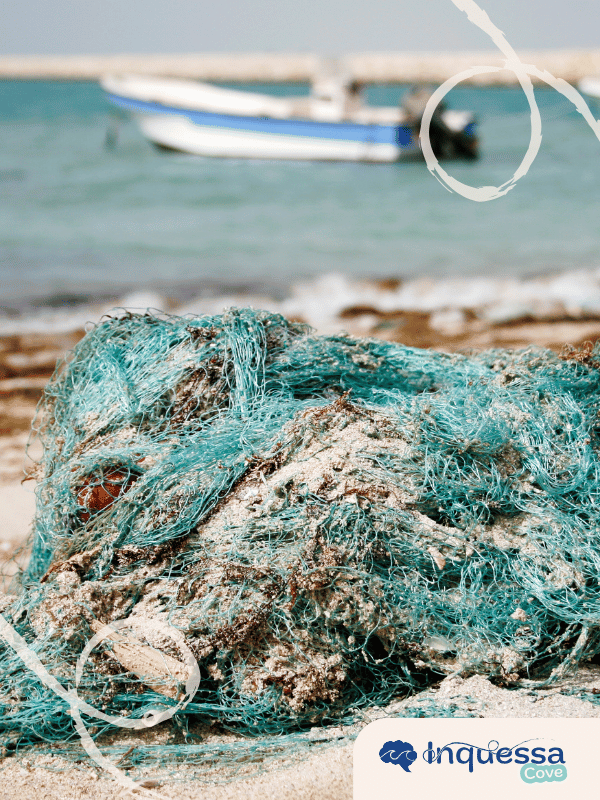
Lost fishing gear can continue doing the job it was designed to do. A fishing net can be lost at sea but continue trapping fish, turtles, or other animals long after people stop using it. This continuing capture by abandoned gear is called ghost fishing.
Lost or discarded fishing gear can continue capturing or entangling wildlife even though no fisher is actively using it. The problem can continue as long as the gear remains able to trap animals.
Ghost fishing does not mean that every lost net or line will keep catching animals forever. The risk depends on the kind of gear, where it is, and what happens to it over time.
Why Nets and Lines Are Hard to Remove
Finding and removing lost fishing gear is not always simple. Gear may be spread across a large area, floating near the surface, drifting below it, or caught around underwater features.
Not all plastic in the Great Pacific Garbage Patch is tiny. Some of it includes fishing nets so large that their size is measured in meters. Large nets may be easier to notice than tiny fragments, but their size can also make them difficult to handle.
Removing gear must also be done carefully so that the process does not create additional problems for animals or habitats.
Preventing Gear From Becoming Waste
Preventing fishing gear from becoming ocean waste can involve several different approaches. Gear can be repaired and maintained so it is less likely to break or be lost. Tracking or marking equipment can also make it easier to identify and recover.
Communities may support retrieval, locating and removing lost or abandoned fishing gear from the water. Retrieval can reduce the time gear remains in the ocean, but it is only one part of prevention.
Keeping gear in use, repairing damaged equipment, tracking losses, and recovering abandoned gear all address the problem at different stages. Lost fishing gear is one specific form of ocean plastic pollution, and reducing it depends on preventing useful equipment from becoming long-lasting waste.
Fishing Gear Made From Plastic
Fishing gear is designed to work in water, where it may need to remain strong, flexible, and useful for long periods. Nets, lines, ropes, and traps can all contain plastic materials.
These items are different from many familiar pieces of ocean litter. A bottle or wrapper may drift through the water, but fishing gear was originally designed to catch or hold animals. Therefore, that same design can become a problem if the gear remains in the ocean after people stop using it.
When Gear Is Lost or Abandoned
Storms, damage, accidents, or other events can separate fishing gear from the people using it. Lost fishing gear is fishing equipment such as nets, lines, or traps that remains in the water after it is lost or abandoned.
A lost net may drift through open water, while a line or trap may remain in one area. Gear can also become tangled around rocks, reefs, or other objects. Once equipment is separated from its owner, however, finding it again may be difficult.
Ghost Fishing
Lost fishing gear can continue doing the job it was designed to do. A fishing net can be lost at sea but continue trapping fish, turtles, or other animals long after people stop using it. This continuing capture by abandoned gear is called ghost fishing.
Lost or discarded fishing gear can continue capturing or entangling wildlife even though no fisher is actively using it. The problem can continue as long as the gear remains able to trap animals.
Ghost fishing does not mean that every lost net or line will keep catching animals forever. The risk depends on the kind of gear, where it is located, and what happens to it over time.
Why Nets and Lines Are Hard to Remove
Finding and removing lost fishing gear is not always simple. Gear may be spread across a large area, floating near the surface, drifting below it, or caught around underwater features.
Not all plastic in the Great Pacific Garbage Patch is tiny. Some of the debris includes fishing nets so large that their size is measured in meters. Although large nets may be easier to notice than tiny fragments, their size can also make them difficult to handle.
Removing gear must also be done carefully so that the process does not create additional problems for animals or habitats.
Preventing Gear From Becoming Waste
Preventing fishing gear from becoming ocean waste can involve several different approaches. Gear can be repaired and maintained so that it is less likely to break or be lost. Tracking or marking equipment can also make it easier to identify and recover.
Communities may support retrieval, which means locating and removing lost or abandoned fishing gear from the water. Retrieval can reduce the time gear remains in the ocean; however, it is only one part of prevention.
Keeping gear in use, repairing damaged equipment, tracking losses, and recovering abandoned gear all address the problem at different stages. Lost fishing gear is one specific form of ocean plastic pollution, and reducing it depends on preventing useful equipment from becoming long-lasting waste.
Key Vocabulary
abandoned (adjective) Left behind and no longer being used or cared for. (left behind, deserted)
flexible (adjective) Able to bend without easily breaking. (bendable, pliable)
ocean litter (noun) Waste or discarded material found in the ocean. (marine litter, ocean waste)
capture (verb) To catch and prevent an animal from moving away. (catch, trap)
entangle (verb) To catch or twist something in nets, lines, ropes, or other material. (tangle, trap)
drift (verb) To be carried slowly by water, wind, or currents. (float, move)
open water (noun) An area of water away from the shore or other nearby features. (open sea, exposed water)
underwater feature (noun) A natural structure below the water, such as a reef or rock formation. (submerged feature, underwater structure)
maintain (verb) To care for equipment so it stays in useful working condition. (look after, preserve)
tracking (noun) Following or recording the location or movement of something. (monitoring, tracing)
marking (noun) ️ Adding identifying information to equipment so it can be recognized or traced. (labeling, identification)
recover (verb) To find and bring back something that was lost. (retrieve, regain)
owner (noun) A person or group that something belongs to. (holder, possessor)
long-lasting (adjective) ⏳ Remaining for a long period of time. (durable, persistent)
