
From Large Plastic to Tiny Plastic
About this Article
Lines of Inquiry
- Changes in plastic as sunlight, weather, friction, and wear act over time.
- Causes that turn one large object into many smaller fragments.
- The difference between fragmentation, decomposition, and disappearance.
Guiding Questions
- Why can a plastic object look as though it is disappearing even when the plastic material is still present?
- How can one small crack lead to much larger changes over time?
- Why might two plastic objects left outdoors break apart at different speeds?
From Large Plastic to Tiny Plastic
Plastic Changes Over Time
Plastic can stay in the environment for a long time, but it does not stay exactly the same. A bottle, bag, foam container, or rope may fade, crack, or become brittle outdoors.
Plastic often does not decompose like food scraps or leaves. Instead, a large object may weaken and split into smaller pieces that are still plastic.
Sunlight, Heat, and Weather
The combined effects of sunlight, changing temperatures, wind, and water are called weathering.
Over time, sun, heat, wind, and waves can make sturdy plastics brittle, causing them to fracture into progressively smaller pieces that may never fully go away. Weathering can weaken the surface until cracks form.
Waves, Rocks, and Friction
Movement can make the process faster. Friction is rubbing between surfaces.
Plastic in the ocean may rub against sand, rocks, other debris, or itself as waves move it. Plastic on land may be scraped by shoes, vehicles, or weather. This rubbing can wear the material down.
From Cracks to Smaller Pieces
As plastic becomes weaker, pieces can break away. Fragmentation is the process of a larger piece breaking into smaller pieces.
A bottle may become several pieces. Those pieces can later break again. The object becomes harder to recognize, but the plastic material is still present.
Smaller Does Not Mean Gone
Microplastics are plastic pieces smaller than 5 millimeters, but their small size does not mean the plastic has disappeared.
Tiny pieces can spread through water, soil, and air more easily than a large object. Plastic can therefore become less visible while remaining in the environment.
Plastic Changes Over Time
Plastic can last in the environment for a long time, but it does not stay exactly the same. A bottle, bag, foam container, or piece of rope may fade, crack, become brittle, or wear down as it is exposed to the outdoors.
These changes are different from decomposition. Materials such as food scraps or leaves can break down into other substances. Plastic often follows another path. Instead of fully disappearing, a larger object may weaken and split into smaller pieces that are still made of plastic.
Sunlight, Heat, and Weather
When sunlight, water, temperature changes, or rubbing slowly break down material, the process is called weathering. Plastic weathering develops over time as sunlight, waves, heat, and repeated physical wear weaken the material.
Over time, sun, heat, wind, and waves can make sturdy plastic brittle. It can then break into smaller and smaller pieces that may never fully disappear. A discarded container, for example, can slowly lose its flexibility, develop cracks, and break apart as new surfaces continue facing the weather. Weathering does not make plastic vanish. It weakens the material so other forces can break it more easily.
Waves, Rocks, and Friction
Once plastic has weakened, movement can speed up the physical wear. Waves may push a bottle against sand, drag rope across rocks, or toss fragments against other debris.
Friction, the rubbing that happens between surfaces, can help break plastic into smaller fragments over time. Repeated scraping, bending, and impact can roughen plastic surfaces and make weak points larger. Ocean waves can cause this kind of wear, but plastic can also be rubbed, bent, or scraped in other environments.
From Cracks to Smaller Pieces
A small crack can become the starting point for a much larger change. As weathering and repeated wear weaken an object, pieces may snap away. Those pieces can then weather and break again.
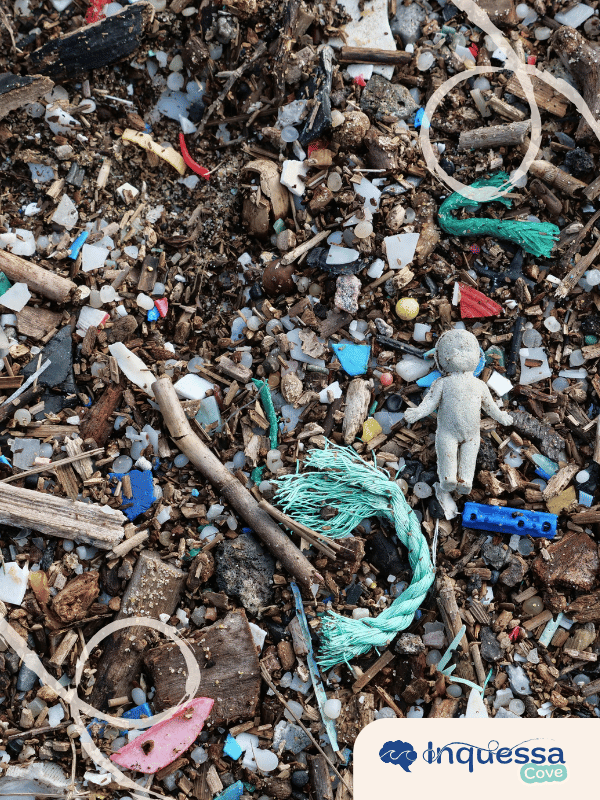
Fragmentation occurs as sunlight, waves, friction, and weather break larger plastic into progressively smaller pieces. A bottle, bag, foam container, or rope may eventually become many fragments instead of one recognizable object.
The process does not happen at one fixed speed. Different plastics face different amounts of sunlight, heat, movement, and wear, so some break apart faster than others.
Smaller Does Not Mean Gone
As fragmentation continues, the pieces can become extremely small. Microplastics are plastic pieces smaller than 5 millimeters. Being small does not mean the plastic has disappeared.
A fragment may become difficult to notice even though the material itself is still present. The original bottle or container may no longer be recognizable, yet the plastic has only changed in size and shape.
That difference is important. Breaking, fragmenting, and decomposing are not the same process. Plastic can become smaller and smaller through weathering and physical wear while remaining plastic in the environment.
Plastic Changes Over Time
Plastic can last in the environment for a long time, but it does not stay exactly the same. A bottle, bag, foam container, or piece of rope may fade, crack, become brittle, or wear down as it is exposed to the outdoors.
These changes are different from decomposition. Materials such as food scraps or leaves can break down into other substances. Plastic often follows another path. Instead of fully disappearing, a larger object may weaken and split into smaller pieces that are still made of plastic.
Sunlight, Heat, and Weather
Left outdoors, plastic is exposed to natural forces again and again. The combined effects of sunlight, shifting temperatures, wind, and water gradually break down materials in a process known as weathering. Over time, sun, heat, wind, and waves can make sturdy plastics brittle, causing them to fracture into progressively smaller pieces that may never fully go away.
A discarded container, for instance, can slowly lose its flexibility, develop cracks, and break apart as newly exposed surfaces continue facing the elements. Weathering does not make the plastic vanish. It weakens the material so that other forces can break it more easily.
Waves, Rocks, and Friction
Once plastic has weakened, movement can speed up the physical wear. Waves may push a bottle against sand, drag rope across rocks, or toss fragments against other debris.
As surfaces rub against one another, friction resists their movement and can gradually wear them down. Repeated scraping, bending, and impact can roughen plastic surfaces and enlarge weak points that have already formed. Ocean waves can cause this kind of wear, but they are not the only source. Plastic can also be rubbed, bent, or scraped in other environments long before it reaches the sea.
From Cracks to Smaller Pieces
A small crack can become the starting point for a much larger change. As weathering and repeated wear weaken an object, pieces may snap away. Those pieces can then weather and break again.
This repeated physical breaking is called fragmentation. Fragmentation occurs as larger plastic objects break into progressively smaller pieces without fully disappearing. A bottle, bag, foam container, or rope may eventually become many fragments instead of one recognizable object.
The process does not happen at one fixed speed. Different plastics face different amounts of sunlight, heat, movement, and wear, so some break apart faster than others.
Smaller Does Not Mean Gone
As fragmentation continues, the pieces can become extremely small. Microplastics are plastic pieces smaller than 5 millimeters, but their small size does not mean the plastic has disappeared.
A fragment may become difficult to notice even though the material itself is still present. The original bottle or container may no longer be recognizable, yet the plastic has only changed in size and shape.
That difference is important. Breaking, fragmenting, and decomposing are not the same process. Plastic can become smaller and smaller through weathering and physical wear while remaining plastic in the environment.
Plastic Changes Over Time
Plastic can last in the environment for a long time, but it does not remain exactly the same. A bottle, bag, foam container, or piece of rope may fade, crack, become brittle, or wear down as it is exposed to outdoor conditions.
These changes are different from decomposition. Materials such as food scraps or leaves can break down into other substances. Plastic often follows a different pathway. Instead of fully disappearing, a larger object may weaken and split into smaller pieces that are still made of plastic.
Sunlight, Heat, and Weather
Left outdoors, plastic is exposed to natural forces again and again. Weathering is the gradual change caused when sunlight, shifting temperatures, wind, and water act on a material over time. Over time, sunlight, heat, wind, and waves can make sturdy plastics brittle, causing them to fracture into progressively smaller pieces that may never fully disappear.
A discarded container, for example, can slowly lose its flexibility, develop cracks, and break apart as newly exposed surfaces continue facing the elements. Weathering does not make the plastic vanish. Instead, it weakens the material, making it easier for other forces to break the object apart.
Waves, Rocks, and Friction
Once plastic has weakened, movement can speed up physical wear. Waves may push a bottle against sand, drag rope across rocks, or toss fragments against other debris.
As surfaces rub or move against one another, friction creates resistance and can gradually wear them down. Repeated scraping, bending, and impact can roughen plastic surfaces and enlarge weak points that have already formed. Although ocean waves can cause this kind of wear, plastic can also be rubbed, bent, or scraped in other environments long before it reaches the sea.
From Cracks to Smaller Pieces
A small crack can become the starting point for a much larger change. As weathering and repeated wear weaken an object, pieces may snap away. Those pieces can then weather, experience more friction, and break again.
This repeated physical breaking is called fragmentation. Fragmentation occurs as larger plastic objects break into progressively smaller pieces without fully disappearing. A bottle, bag, foam container, or rope may therefore become many fragments instead of one recognizable object.
The process does not happen at one fixed speed. Different plastics experience different amounts of sunlight, heat, movement, and wear, so some may break apart faster than others.
Smaller Does Not Mean Gone
Microplastics are plastic pieces smaller than 5 millimeters; however, their small size does not mean the plastic has disappeared.
A fragment may become difficult to notice even though the material itself is still present. The original bottle or container may no longer be recognizable, yet the plastic has changed mainly in size and shape rather than simply vanishing.
That distinction is important. Breaking, fragmentation, and decomposition are not the same process. Plastic can become progressively smaller through weathering and physical wear while remaining plastic in the environment.
Key Vocabulary
brittle (adjective) Hard but easy to crack or break. (fragile, breakable)
decomposition (noun) The process of breaking down into different substances over time. (decay, breakdown)
physical wear (noun) Damage or change caused by repeated rubbing, scraping, bending, or impact. (wear and tear, abrasion)
exposed (adjective) ☀️ Open to contact with sunlight, weather, water, or other conditions. (unprotected, uncovered)
surface (noun) The outer part of an object. (outer layer, exterior)
weak point (noun) ⚠️ An area of a material that is easier to crack or break. (vulnerable spot, weak area)
impact (noun) The force created when one object strikes another. (collision, blow)
fracture (verb) To crack or break into pieces. (split, break)
fragment (noun) A small piece broken from a larger object. (piece, shard)
progressively (adverb) Gradually, in a series of continuing steps. (increasingly, little by little)
recognizable (adjective) Easy to identify because its original form can still be seen. (identifiable, familiar)
flexibility (noun) The ability of a material to bend without breaking. (bendability, suppleness)
outdoor conditions (noun) ️ Sunlight, temperature, wind, water, and other conditions a material experiences outside. (weather conditions, environmental conditions)
