
When Recycling Gets Contaminated
About this Article
Lines of Inquiry
- Different causes of recycling contamination and the problems each can create.
- The ways food residue, mixed materials, tanglers, and small pieces interfere with different parts of the sorting process.
- The role of contamination in changing material quality, processing difficulty, and recycling outcomes.
Guiding Questions
- How can food residue and a plastic bag both cause recycling problems in completely different ways?
- Why does cleaning an item not make an otherwise non-recyclable material recyclable?
When Recycling Gets Contaminated
When the Wrong Things Go In
Recycling works best when the items entering the system match what the facility can handle. Recycling contamination happens when unwanted materials become mixed with recyclables and interfere with sorting or processing.
Food, liquids, non-recyclable plastics, and incorrectly sorted items can all create problems. They may lower the quality of useful material or make processing more expensive.
Food and Liquid Left Behind
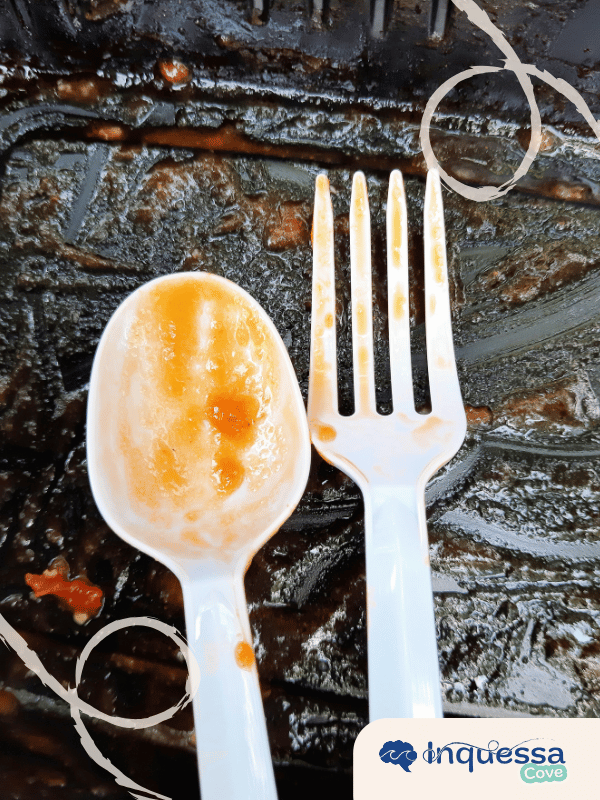
A container does not always need to look perfectly clean before recycling. But large amounts of food or liquid can spill onto paper, cardboard, or other materials.
A container that has most food scraped away can be called spatula-clean. Accepted food containers can often be rinsed or scraped clean enough for recycling. Being “spatula-clean” can be enough. The goal is to remove most leftovers, not make the container look new.
Plastic Mixed With Other Materials
Some items combine plastic with paper, metal, or other materials. If these parts cannot be separated, the whole item may be difficult to process.
Contamination is therefore not only about dirt. It can also happen when the wrong kind of object enters a recycling stream.
Tanglers, Bags, and Small Pieces
A tangler is a flexible item that can wrap around recycling equipment and interfere with sorting.
Plastic bags, wires, clothing, and string lights can become tangled in sorting equipment and stop the process. Workers may have to pause machinery to remove them safely. Very small pieces can also be difficult for equipment to sort.
How Contamination Changes the Outcome
Contamination can make recyclable material harder or more expensive to process. Some otherwise useful material may be rejected.
One wrong item does not automatically ruin everything around it, and cleaning a container does not make every kind of plastic recyclable. Keeping unwanted items out gives accepted materials a better chance of moving through the system.
When the Wrong Things Go In
Recycling works best when the materials entering the system match what the facility is designed to handle. When unwanted materials get mixed with recyclables, the problem is called recycling contamination. Food residue, liquids, non-recyclable plastics, or mixed materials can contribute to recycling contamination.
High levels of recycling contamination can cause otherwise useful materials to be rejected, lowering the amount that is successfully recycled. Contamination can also make sorting harder and processing more expensive.
Food and Liquid Left Behind
A bottle or container does not always need to look perfectly clean before recycling. However, large amounts of food or liquid can spill onto paper, cardboard, or other materials and make them harder to process.
Spatula-clean describes packaging with most food scraped away, rather than a container still holding a large amount of food or liquid. Accepted food containers can often be rinsed or scraped clean enough for recycling. Being spatula-clean may be enough. Removing most of the leftover food matters more than making every container look new.
Plastic Mixed With Other Materials
Some items create contamination because they combine materials that do not belong together in the same recycling stream. A snack wrapper, for example, may contain several layers. Another object may combine plastic with paper, metal, or another material.
If those materials cannot be separated easily, the whole item may be difficult for the recycling system to handle. Mixed items can also be mistaken for materials that a facility does accept. Contamination is therefore not only about dirt. It can also happen when the wrong type of object enters the recycling stream.
Tanglers, Bags, and Small Pieces
An item that can wrap around recycling equipment is called a tangler.
Plastic bags, wires, clothing, and string lights can become tangled in recycling equipment and stop the sorting process. Workers may have to stop the machinery so the material can be removed safely. Small pieces such as straws or loose bits of plastic can also be difficult for equipment to sort because they may fall between other materials or move unpredictably.
How Contamination Changes the Outcome
Contamination can change what happens to an entire group of recyclables. Materials that could have been useful may become harder to sort, more expensive to process, or too dirty to sell as recycled material.
One incorrect item does not necessarily ruin everything around it, and rinsing a container does not make every kind of plastic recyclable. The outcome depends on the material, the amount of contamination, and the recycling system handling it. Keeping unwanted materials out of the recycling stream gives accepted materials a better chance of moving successfully through the process.
When the Wrong Things Go In
Recycling works best when the materials entering the system match what the facility is designed to handle. When unwanted materials become mixed with recyclables and interfere with sorting or processing, the problem is called recycling contamination.
Food residue, liquids, non-recyclable plastics, and incorrectly sorted items can all cause contamination. These materials may make useful recyclables harder to separate or lower the quality of what is collected. High contamination can also make processing more expensive or cause otherwise recyclable material to be rejected.
Food and Liquid Left Behind
A bottle or container does not always need to look perfectly clean before recycling. However, large amounts of food or liquid can spill onto paper, cardboard, or other materials and make them harder to process.
A container that has been scraped mostly clean can be called spatula-clean, unlike one that still contains significant food residue. Accepted food containers can often be rinsed or scraped clean enough for recycling, and being spatula-clean may be enough. This means removing most of the leftover food is more important than making every container look new.
Plastic Mixed With Other Materials
Some items create contamination because they combine materials that do not belong together in the same recycling stream. A snack wrapper, for example, may contain several layers, while another object may combine plastic with paper, metal, or another material.
If those materials cannot be separated easily, the whole item may be difficult for the recycling system to handle. Mixed items can also be mistaken for materials that a facility does accept. Contamination is therefore not only about dirt. It can also happen when the wrong type of object enters the recycling stream.
Tanglers, Bags, and Small Pieces
Some flexible items can cause a different kind of problem. A tangler is a flexible item that can wrap around recycling equipment and interfere with sorting.
Plastic bags, wires, clothing, and string lights can become tangled in sorting equipment and stop the process. Workers may have to pause machinery so the material can be removed safely. Small pieces such as straws or loose bits of plastic can also be difficult for equipment to sort correctly because they may fall between other materials or move unpredictably.
How Contamination Changes the Outcome
Contamination can change what happens to an entire group of recyclables. Materials that could have been useful may become harder to sort, more expensive to process, or too dirty to sell as recycled material.
One incorrect item does not necessarily ruin everything around it, and rinsing a container does not make every kind of plastic recyclable. The outcome depends on the material, the amount of contamination, and the recycling system handling it. Keeping unwanted materials out of the recycling stream gives accepted materials a better chance of moving successfully through the process.
When the Wrong Things Go In
Recycling works best when the materials entering the system match what the facility is designed to handle. When unwanted materials become mixed with recyclables and interfere with sorting or processing, the problem is called recycling contamination.
Food residue, liquids, non-recyclable plastics, and incorrectly sorted items can all cause contamination. These materials may make useful recyclables harder to separate or lower the quality of what is collected. As a result, high contamination can make processing more expensive or cause materials that could have been recycled to be rejected.
Food and Liquid Left Behind
A bottle or container does not always need to look perfectly clean before recycling. However, large amounts of food or liquid can spill onto paper, cardboard, or other materials and make them harder to process.
A container that has been scraped mostly clean can be described as spatula-clean. Accepted food containers can often be rinsed or scraped clean enough for recycling. Being “spatula-clean” may be enough. The goal is therefore to remove most of the leftover food, not to make every container look completely new.
Plastic Mixed With Other Materials
Some items create contamination because they combine materials that do not belong together in the same recycling stream. A snack wrapper, for example, may contain several layers, while another object may combine plastic with paper, metal, or another material.
If those materials cannot be separated easily, the whole item may be difficult for the recycling system to handle. Mixed items can also be mistaken for materials that a facility does accept. Recycling contamination is therefore not only about dirt or leftover food. It can also happen when the wrong type of object enters the recycling stream.
Tanglers, Bags, and Small Pieces
Some flexible items create a different kind of problem. A tangler is a flexible discarded item, such as a bag, cord, or hose, that can become wound around sorting machinery.
Plastic bags, wires, clothing, and string lights can become tangled in recycling equipment and stop the sorting process. Workers may then need to pause the machinery so the tangled material can be removed safely. Small pieces such as straws or loose bits of plastic can also be difficult for equipment to sort because they may fall between other materials or move in unexpected ways.
How Contamination Changes the Outcome
Contamination can affect what happens to an entire group of recyclables. Materials that could have been useful may become harder to sort, more expensive to process, or too dirty to sell as recycled material.
However, one incorrect item does not necessarily ruin everything around it, and rinsing a container does not make every kind of plastic recyclable. The outcome depends on the material, the amount of contamination, and the recycling system handling it. Keeping unwanted materials out of the recycling stream gives accepted materials a better chance of moving successfully through the process.
Key Vocabulary
food residue (noun) ️ Food or liquid left behind inside or on a container. (leftovers, remaining food)
recycling stream (noun) ♻️ The flow of accepted recyclable materials through collection and processing. (material stream, recycling flow)
mixed material (noun) An item made from different materials that may be difficult to separate. (combined material, multi-material item)
sorting machinery (noun) Equipment used to identify and separate materials in a recycling facility. (sorting equipment, recycling machines)
rejected material (noun) Material removed because it cannot successfully continue through the recycling process. (rejected recycling, discarded material)
interfere (verb) ⚠️ To get in the way of a process and make it work less effectively. (disrupt, obstruct)
non-recyclable (adjective) Not able to be accepted or successfully processed through a particular recycling system. (not recyclable, unaccepted)
leftover liquid (noun) Liquid remaining inside a container after use. (remaining liquid, residue)
sorting process (noun) ⚙️ The steps used to separate materials into the correct groups. (separation process, recycling sorting)
wrap around (verb) To wind or twist around another object. (entangle, coil around)
processing cost (noun) The expense involved in sorting and preparing recyclable material. (recycling expense, handling cost)
material quality (noun) How clean and useful a recovered material is for later processing or sale. (recycling quality, material condition)
